
If you hold DOT and stake it through a liquid staking protocol, you're probably not extracting the maximum yield available to you. Not because your strategy is wrong. Because of a routing choice most people never think about.
Minting vDOT vs swapping for vDOT. Same token, same protocol, meaningfully different output.
vDOT is Bifrost's liquid staking token for Polkadot. Stake DOT through Bifrost and you receive vDOT: a yield-bearing token that appreciates against DOT as staking rewards accumulate.
Unlike traditional staking, vDOT is tradeable. You can hold it, use it in other DeFi positions, or redeem it back to DOT after the standard 28-day unbonding period.
The exchange rate is not 1:1. Because vDOT accumulates staking rewards over time, it takes progressively fewer vDOT to represent 1 DOT. One DOT is worth more than 1 vDOT, and that ratio moves continuously upward.
Minting means depositing DOT directly into the Bifrost liquid staking contract. The protocol issues you vDOT at the current internal exchange rate.
Swapping means buying vDOT from a liquidity pool on the open market. The rate you get depends on supply and demand at that moment, not on the protocol rate.
Most users mint by default, which is a completely reasonable choice. But the swap route frequently returns more vDOT for the same DOT input. That gap is worth checking.
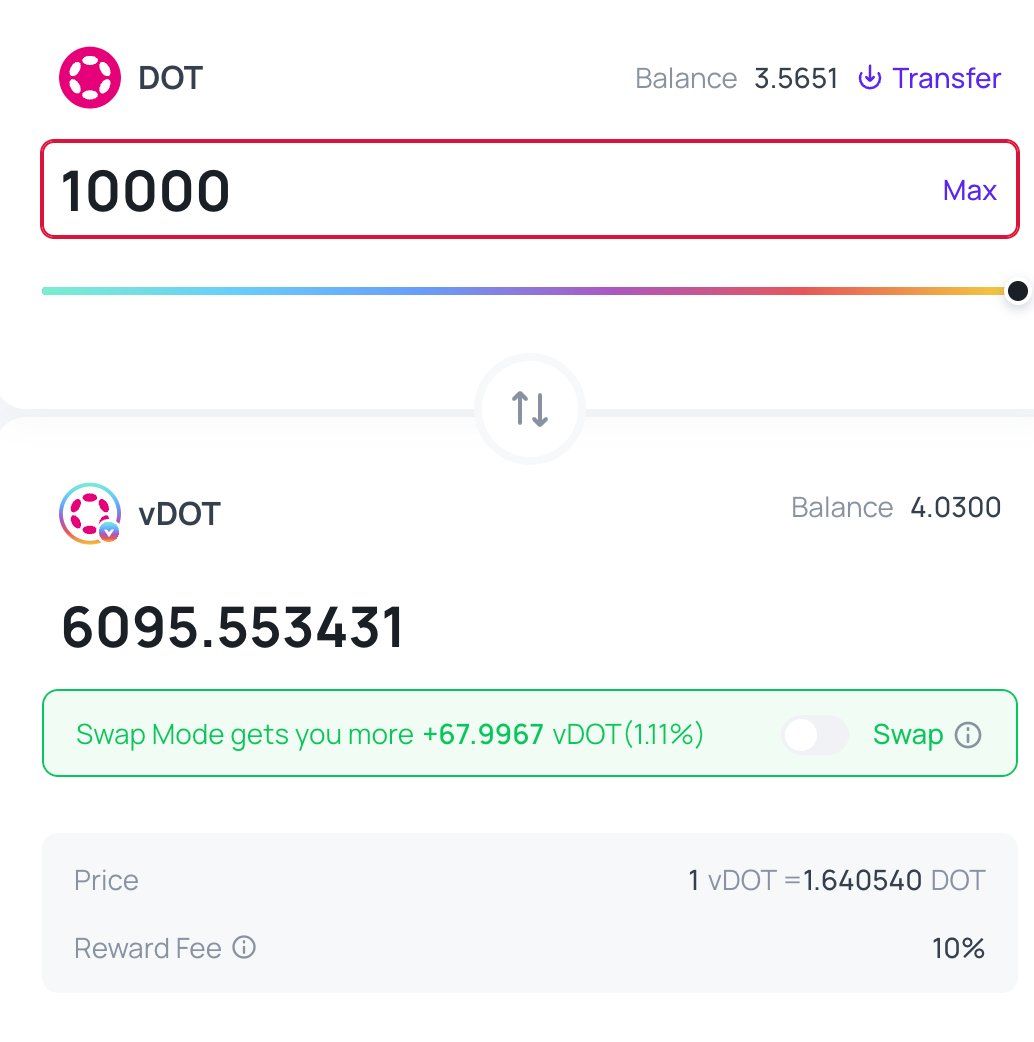
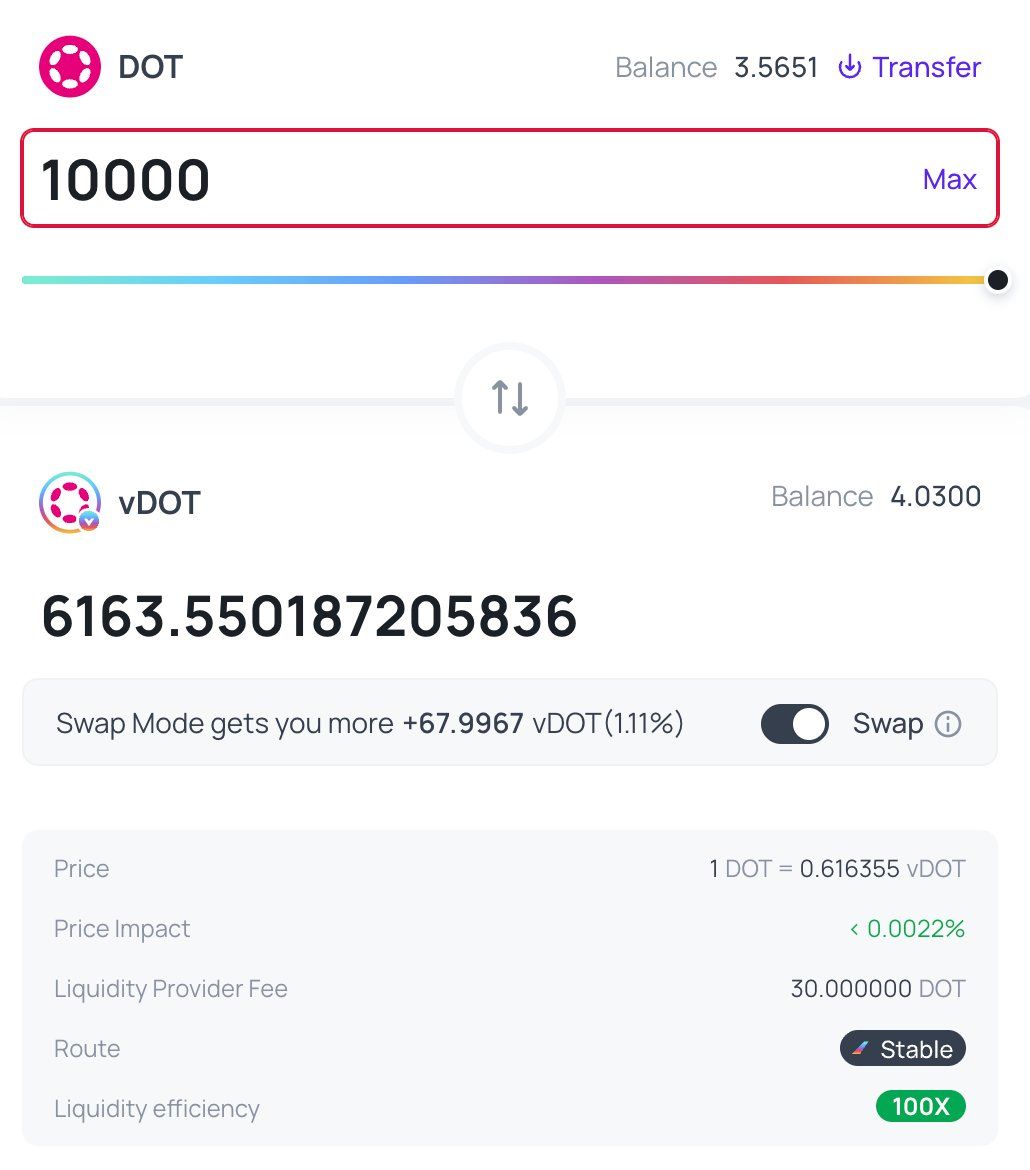
Here's a concrete illustration using a 10,000 DOT position:
| Route | DOT Input | vDOT Received |
|---|---|---|
| Mint | 10,000 | 6,096.216 |
| Swap | 10,000 | 6,163.550 |
| Difference | — | +67.334 vDOT |
Swapping yields 67.334 more vDOT than minting for the same 10,000 DOT input.
This might seem like a small number — but consider what it means at redemption. Since all vDOT remains redeemable for underlying DOT after the unbonding period, those extra 67.334 vDOT are not just tokens — they represent a claim on real DOT.
At the time of this calculation, that swap position could be redeemed for approximately 10,100 DOT.
On a 10,000 DOT position, that's a 100 DOT gain from better routing alone.
The 28-day unbonding period gives a natural holding window to work with. A 67.334 vDOT spread on a 10,000 DOT position, annualized over roughly 28 days, comes out to about 13% APR.
This is not a guaranteed rate. The spread between the mint price and the market price shifts constantly with liquidity conditions. Some days the gap is bigger. Some days it narrows to almost nothing. But the principle holds: when the market trades vDOT below its protocol value, the user who buys via swap gets more vDOT per DOT than the user who mints.
No flash loans. No bots. No proprietary data. Just checking which number is bigger before you transact.
The mint rate is set by the protocol and updates periodically based on accumulated staking rewards. It does not react to short-term buying and selling pressure.
The swap rate is set by the liquidity pool. When vDOT supply in the pool is high (because earlier stakers are selling, or because the spread hasn't been fully arbitraged away), you can buy vDOT at a discount to what the protocol would give you for direct minting.
This is a temporary pricing inefficiency. As more users notice and act on the spread, it narrows. That's how arbitrage works in any open market. The gap exists right now because not everyone is looking for it.
A few situations where the swap route deserves a careful look:
You're planning to liquid stake anyway. If you were going to mint, checking the swap rate first costs nothing. If the swap gives you more vDOT, take it.
You're working with a larger position. On 100 DOT, a 13% routing advantage is real but modest in absolute terms. On 10,000 DOT, it starts to matter in ways that are harder to ignore.
You have patience for the 28-day window. The redemption math only works cleanly if you can wait through unbonding. If you need fast liquidity, the calculus changes.
The comparison takes a few minutes.
The entire check takes less time than most people spend on gas decisions.
This isn't unique to vDOT. It's something DeFi does that traditional finance doesn't: the pricing data is public and available to anyone.
In traditional markets, institutions see better prices because they have better access. In DeFi, the pool depth, the exchange rate, and the spread between mint and market price are all on-chain. A retail user with ten minutes and a working wallet can see exactly what a large fund sees.
Most DOT stakers never compare both routes. They mint, which works fine. The users who do check both routes consistently pick up yield that the others leave behind. Not because they have a technical edge. Because they took the extra step.
The underlying risks are broadly similar: DOT price exposure and Bifrost protocol risk apply to both. The main swap-specific consideration is slippage. On large positions, your trade can move the pool price against you, narrowing or eliminating the spread advantage. Check your estimated output carefully before executing.
It varies. The spread depends on pool composition and recent trading activity. When there's heavy selling pressure on vDOT, the swap tends to outperform. When demand for vDOT is high, minting may offer the better rate. The only way to know is to check both at the time of your trade.
No. If you hold DOT in a wallet connected to Bifrost, you can mint or swap vDOT directly. No prior staking position required.
Tax treatment of DeFi yield varies by jurisdiction. This article is not financial or tax advice. Consult a qualified professional for your situation.
vDOT can be acquired two ways on Bifrost: minting at the protocol rate, or swapping at the market rate. The swap route frequently returns more vDOT per DOT. On a 10,000 DOT position, the difference was 67.334 vDOT, equivalent to roughly 13% APR over a 28-day hold.
The spread exists because DeFi markets are not perfectly efficient. It persists because most users don't check. The comparison takes a few minutes. Whether the math works in your favor depends on the day, but it's always worth looking.
This article is for informational purposes only and does not constitute financial advice. DeFi protocols carry smart contract risk. Always do your own research before transacting.


