In traditional staking, tokens are locked for a period, preventing their use. If you want to vote on a proposal, you must unstake your tokens, which means you lose staking rewards.
Bifrost's LST Governance introduces a new way to participate in decentralized decision-making without losing rewards:
- Governance Participation: LST holders can vote on proposals within the Bifrost ecosystem. These proposals may include updates to network settings or new features, helping to shape the network’s future.
- Staking Rewards: Holders continue to earn staking rewards while they vote. This means your assets are working for you, generating passive income while you participate in governance.
LST Governance Features
Bifrost LST governance includes the following features:
- View ongoing proposals on the main chain
- Vote Aye, Nay, or Abstain
- Choose conviction level
- Lock vTokens to vote
- Unlock vTokens after the lock period ends
How to experience LST governance on Bifrost
To understand vToken Voting, it is helpful to know how Bifrost LST and governance voting work, using vDOT as an example:
- Addresses that stake DOT on Polkadot can participate in governance voting.
- DOT staked for vDOT is controlled by derived addresses from Bifrost’s sovereign address on Polkadot. These addresses also have governance voting rights.
- Bifrost’s sovereign address is a Polkadot parachain address: 13YMK2eeopZtUNpeHnJ1Ws2HqMQG6Ts9PGCZYGyFbSYoZfcm. The derived addresses used for staking and voting are keyless addresses.
- Bifrost carries out governance voting on Polkadot through XCM calls to these derived addresses.
vToken Governance Lock
When a user votes in governance using vToken, the corresponding vToken is locked based on the user’s chosen settings. Locked vTokens cannot be transferred or redeemed. However, this does not affect the yield from exchange rate increases.
An increase in the vToken exchange rate does not automatically increase its supply. When the governance lock period ends, the vToken is unlocked.
Governance Lock Amount
A user’s vToken can participate in multiple governance referendums at once, so the lock duration varies. The governance lock amount is calculated based on the total vTokens held by the user. This allows vDOT to participate in multiple votes simultaneously.
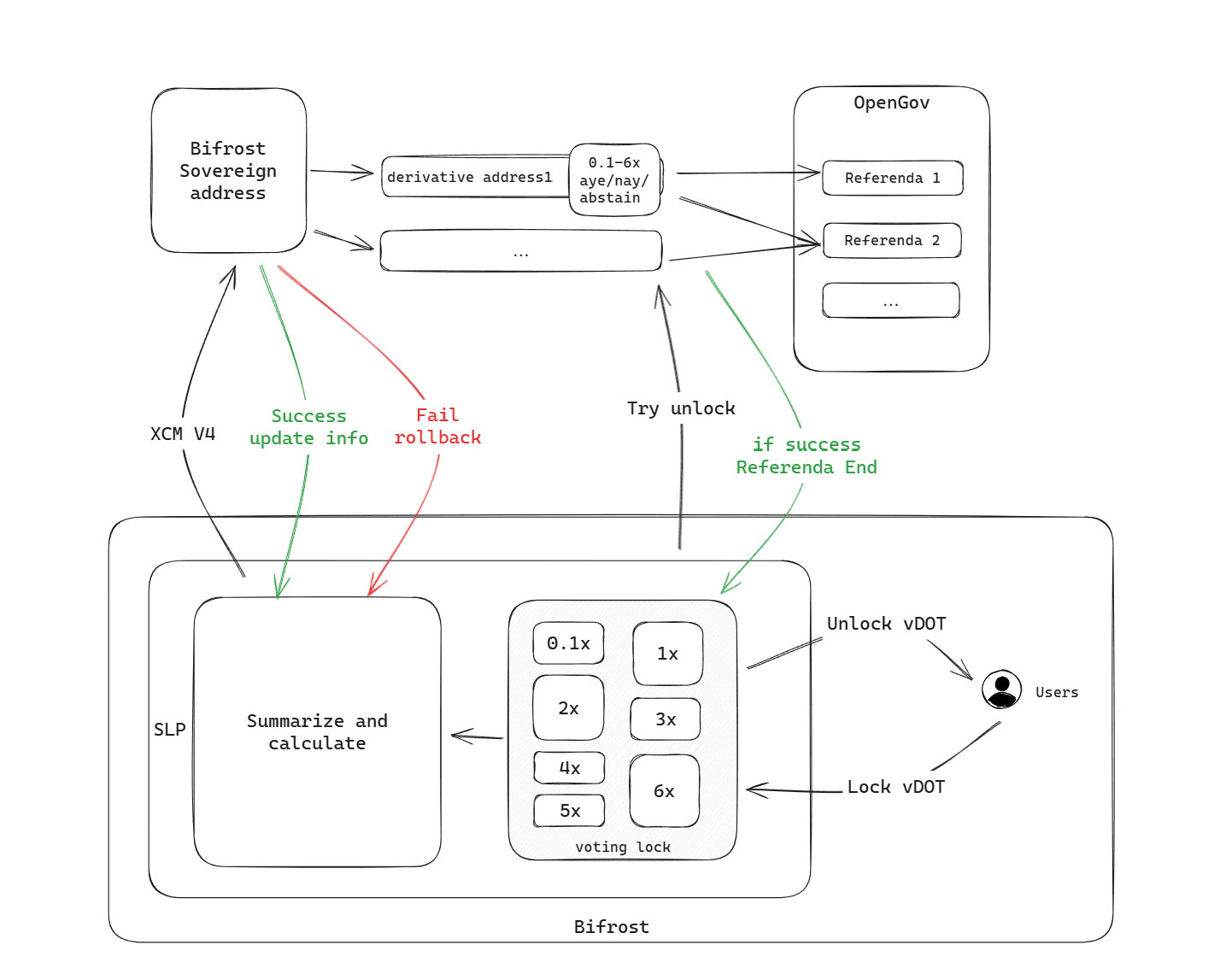
Here is how vToken Voting works:
- Assume a Bifrost user locks 10 vDOT to vote for Referenda 1 with a 3x Conviction.
- The SLP module calculates the amount of vDOT equal to 12 DOT (assuming a 1:1.2 vDOT-DOT exchange rate). Based on the vote and the Conviction multiplier, the system makes an XCM call to the derived address under Bifrost’s sovereign address.
- The staked DOT in the derived address determines the maximum voting power. This address votes in favor of Referenda 1 with 12 DOT and locks 3x Conviction.
- When Referenda 1 ends and the Conviction Lock is lifted, Bifrost users can unlock their 10 vDOT. At the same time, the Conviction unlock is executed on Bifrost’s delegated address on the relay chain.